Monday, 22 September 2014

Multiple Intelligences

                Intelligence is not only measurable on an IQ test and there is more to learning than just reading and writing.  Dr. Howard Gardner (Frames of Mind, 1983)  of Harvard University identified multiple intelligences which Boards of Education have been utilizing for some time, in their curriculum.  
                There is evidence that each person has their own unique style of learning.  Everyone's mind operates differently with a  distinctive range of abilities.  Here is a list of the nine different modalities for learning:

1. Bodily/Kinesthetic Intelligence is the proficiency of using
the entire body to express ideas and feelings and the
competence of using the body to produce or transform
things (Gardner, 1983, pp. 205-236).
2. Existential Intelligence is the appreciation of spirituality
and understanding questions about life. This intelligence
relates to exploring human existence in the universe
(Gardner, 1999, p. 115).
3. Interpersonal Intelligence is the proficiency of an
individual in perceiving the moods, aims, motivations, and
emotions of others (Gardner, 1983, pp. 237-276).
4. Intrapersonal Intelligence is having a positive self-concept
and life direction which is intrinsically grounded. The
competency in knowing oneself and acting to modify
oneself based on that knowledge (pp. 237-276).
5. Logical-Mathematical Intelligence involves the elevated
skill of manipulating and understanding numbers and the
ability to reason effectively (pp. 128-169).
6. Musical Intelligence is the ability to appreciate,
distinguish, compose, and perform in various musical
forms (pp. 99-127).
7. Naturalistic Intelligence is the ability to appreciate,
categorize, classify, explain, and connect to things
encountered in nature (Gardner, 1999, p. 115).
8. Verbal/Linguistic Intelligence is the ability to understand,
use, and manipulate written or spoken words productively
(Gardner, 1983, pp. 73-98).
9. Visual/Spatial Intelligence is characterized by being able
to see an image or situation and quickly assess areas that
could be changed to transform or improve the appearance
(Gardner, 1983,pp. 170-204).

                The theory of multiple intelligences and learning styles broadened the classroom to include the world but the use of technology can only go so far.  For example bodily/kinesthetic,  musical ,naturalistic and visual/spatial intelligence have a performance component which includes using the entire body to achieve a full range of knowledge. 

                I am a proponent of travel, hiking, camping, exploring, visiting art galleries, attending symphonies  ...  in essence, living out of the box, to learn.   A couple I know (both educators) took their ten year old daughter out of school for a year to journey with them around the world.  The sum total of their shared experiences could not have been duplicated in school, with or without the use of computers.

                The challenge here is to identify your optimum learning style and to run with it because only then will you reach your full potential!

my grandson, aged five, night exploring

Wednesday, 9 July 2014

How to teach critical thinking skills

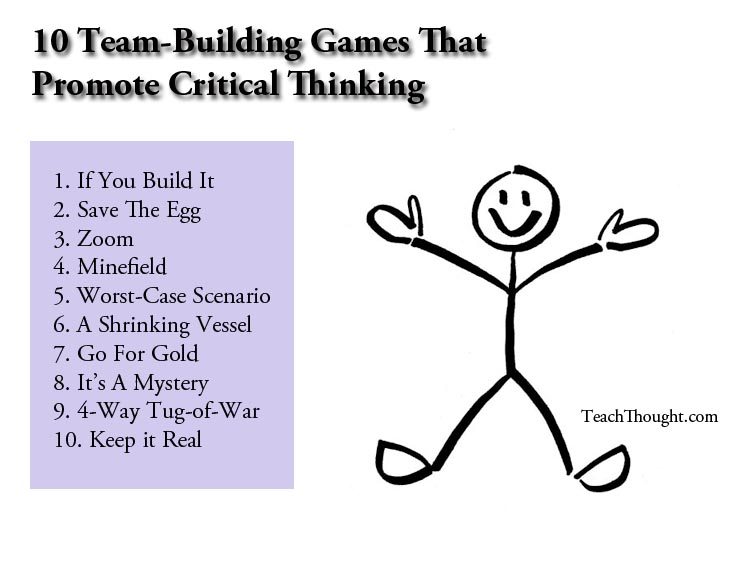
10 Team-Building Games That Promote Critical Thinking

, 
10-team-building-games-that-promote-critical-thinkingOne of education’s primary goals is to groom the next generation of little humans to succeed in the “real world.”
Yes, there are mounds of curricula they must master in a wide breadth of subjects, but education does not begin and end with a textbook or test. Other skills must be honed, too, not the least of which is how to get along with their peers and work well with others. This is not something that can be cultivated through rote memorization or with strategically placed posters.
Students must be engaged and cooperation must be practiced, and often. The following team-building games can promote cooperation and communication, help establish a positive classroom environment and — most importantly — provide a fun, much-needed reprieve from routine.
10 Team-Building Games That Promote Collaborative Critical Thinking
1. If You Build it…
This team-building game is flexible. Simply divide students into teams and give them equal amounts of a certain material, like pipe cleaners, blocks, or even dried spaghetti and marshmallows. Then, give them something to construct. The challenge can be variable (think: Which team can build the tallest, structurally-sound castle? Which team can build a castle the fastest?).
You can recycle this activity throughout the year by adapting the challenge or materials to specific content areas.
Skills: Communication; problem-solving
2. Save the Egg
This activity can get messy and may be suitable for older children who can follow safety guidelines when working with raw eggs. Teams must work together to find a way to “save” the egg (Humpty Dumpty for elementary school students?) — in this case an egg dropped from a specific height. That could involve finding the perfect soft landing, or creating a device that guides the egg safely to the ground. Let their creativity work here.
Skills: Problem-solving, creative collaboration
3. Zoom
Zoom is a classic classroom cooperative game that never seems to go out of style. Simply form students into a circle and give each a unique picture of an object, animal or whatever else suits your fancy. You begin a story that incorporates whatever happens to be on your assigned photo. The next student continues the story, incorporating their photo, and so on.
Skills: Communication; creative collaboration
4. Minefield
Another classic team-building game. Arrange some sort of obstacle course and divide students into teams. Students take turns navigating the “mine field” while blindfolded, with only their teammates to guide them. You can also require students to only use certain words or clues to make it challenging or content-area specific.
Skills: Communication; trust
5. The Worst-Case Scenario
Fabricate a scenario in which students would need to work together and solve problems to succeed, like being stranded on a deserted island or getting lost at sea. Ask them to work together to concoct a solution that ensures everyone arrives safely. You might ask them to come up with a list of 10 must-have items that would help them most, or a creative passage to safety. Encourage them to vote — everyone must agree to the final solution.
Skills: Communication, problem-solving
6. A Shrinking Vessel
This game requires a good deal of strategy in addition to team work. Its rules are deceptively simple: The entire group must find a way to occupy a space that shrinks over time, until they are packed creatively like sardines. You can form the boundary with a rope, a tarp or blanket being folded over or small traffic cones. (Skills: Problem-solving; teamwork)
7. Go for Gold
This game is similar to the “If you build it” game: Teams have a common objective, but instead of each one having the same materials, they have access to a whole cache of materials. For instance, the goal might be to create a contraption with pipes, rubber tubing and pieces of cardboard that can carry a marble from point A to point B in a certain number of steps, using only gravity.
Creative collaboration; communication; problem-solving
8. It’s a Mystery
Many children (and grown-ups) enjoy a good mystery, so why not design one that must be solved cooperatively? Give each student a numbered clue. In order to solve the mystery — say, the case of the missing mascot — children must work together to solve the clues in order. The “case” might require them to move from one area of the room to the next, uncovering more clues.
Skills: Problem-solving, communication
9. 4-Way Tug-of-War 
That playground classic is still a hit — not to mention inexpensive and simple to execute. For a unique variation, set up a multi-directional game by tying ropes in such a way that three or four teams tug at once. Some teams might choose to work together to eliminate the other groups before going head-to-head.
Skills: Team work; sportsmanship
10. Keep it Real
This open-ended concept is simple and serves as an excellent segue into problem-based learning. Challenge students to identify and cooperatively solve a real problem in their schools or communities. You may set the parameters, including a time limit, materials and physical boundaries.
Skills: Problem-solving; communication
While education technology is a basic and crucial component of the 21st century classroom, educators must still ensure that students are engaging with each other in meaningful ways. Team-building exercises are a great way to do this, and because of this, they will never go out of style.
Aimee Hosler is a writer and mother of two living in Virginia. She specializes in a number of topics, but is particularly passionate about education and workplace news and trends. She hold a B.S. in Journalism from California Polytechnic State University in San Luis Obispo and is a contributor to several websites including OnlineSchools.com; 10 Team-Building Games For Kids, Teenagers, or Adults
Retrieved on July 9, 2014, from:

http://www.teachthought.com/teaching/10-team-building-games-that-promote-critical-thinking/


Friday, 27 June 2014

First ever "Patron of the Arts Scholarship"

Here I am conferring the first ever "Patron of the Arts Scholarship" to Chelsea Skerlan, visual art student at Sacred Heart Catholic High School.

Tuesday, 24 June 2014

Another math puzzle. Can you solve it?


 2 x 3, 3 x 4, 4 x 5, 5 x 6, 6 x 7, and 9 x 10 = 90

"The Words That Are Most Known to Only Men or Women" from the Centre for Reading Research

Check this out, it corroborates my thesis paper on gender based learning, posted earlier in this blog:

http://www.slate.com/blogs/business_insider/2014/06/23/center_for_reading_research_study_finds_different_vocabulary_words_are_known.html

Tuesday, 25 March 2014

Speed versus time

This can be confusing. It's about acceleration, deceleration and direction over time. The key is to notice that in A, the car is decelerating out of the box whereas in B, it is accelerating. Therefore, the answer is B.

Monday, 3 March 2014

Mathematics is all about finding a pattern.

Check this out and you will grasp the concept:
http://www.wimp.com/mathriddle/

Monday, 6 May 2013

Michael Moore - Capitalism: A Love Story


... This satirical documentary film revolves around the financial crisis of 2007-2010, and in particular, the recovery stimulus which was brought in by the Bush & Obama administrations. Topics covered include Wall Street's 'casino mentality', for-profit prisons, Goldman Sachs' influence in Washington, DC, the poverty-level wages of many workers, the large wave of home foreclosures, and the consequences of 'runaway greed'.

This film is really worth watching expecially after Occupied Wall Street!!Josephine Catalano Macpherson
Michael Moore -
Capitalism: A Love Story


... This satirical documentary film revolves around the financial crisis of 2007-2010, and in particular, the recovery stimulus which was brought in by the Bush & Obama administrations. Topics covered include Wall Street's 'casino mentality', for-profit prisons, Goldman Sachs' influence in Washington, DC, the poverty-level wages of many workers, the large wave of home foreclosures, and the consequences of 'runaway greed'.

This film is really worth watching especially after Occupied Wall Street!!

Thursday, 10 January 2013

Geometer's Sketchpad, 2012 - 2013

The Geometer's Sketchpad is a useful online software for drawing geometric shapes and doing geometric analyses.

http://www.keypress.com/gsp/download License Name: ONTARIO DSBYORK STUDENT 2012-2013 1   Authorization Code: HQ0Z0K-6ECR8V-JPCG2Z-Q4XZQQ

Sunday, 9 December 2012

Friday, 7 December 2012

"Up Against The Wall", Collage/Mixed Media, 2012

Qualitative Versus Quantitative Data

Qualitative researchers aim to gather an in-depth understanding of human behavior and the reasons that govern such behavior. The qualitative method investigates the why and how of decision making, not just what, where, when. Smaller but focused samples are more often needed than large samples. In the conventional view, qualitative methods produce information only on the particular cases studied, and any more general conclusions are only propositions. So if you wanted to investigate human behaviour, you could conduct case studies of a random group of people and survey them using observation, a questionnaire or an interview. Qualitative research asks broad questions and collects word data from participants. The researcher looks for themes and describes the information in themes and patterns exclusive to that set of participants. Quantitative research is a systematic empirical investigation of social phenomena using statistical, mathematical or computational methods. The objective of quantitative research is to develop and use mathematical models, theories and/or hypotheses pertaining to phenomena. The process of measurement is central to quantitative research because it provides the fundamental connection between empirical observation and mathematical relationships. Quantitative data is any data that is in numerical form such as statistics, percentages, etc. The quantitative researcher asks a specific, narrow question and collects numerical data from participants to answer the question. The researcher analyzes the data with the help of statistics. The researcher is hoping the numbers will yield an unbiased result that can be generalized to some larger population.

Monday, 3 December 2012

Teaching Imperial and Metric Measurement Using the "Julie and Julia" Movie

Julie and Julia, the movie, is a fabulous dual story of two women's lives 50 years apart, one in Queens, U.S.A. and the other in Paris, France. Both women undertake a journey of cooking and writing about their experiences. How does this relate to Math, you ask? Well, it's all about conversions. Julie Powell used imperial measurements while Julia Child used metric measurements. Add to this the fact that Julia Child, while in France, was writing a cookbook for American housewives so had to translate from French into English and convert from metric to imperial measurements. The film chronicles their challenges in two different eras, one blogging online, the other writing a hardcopy cookbook. Different times, similar dilemmas!

Friday, 3 February 2012

David Chilton, author of The Wealthy Barber Revisited, 2011

On Wednesday, February 1st, David Chilton spoke at Chateau Le Jardin in Woodbridge. He highlighted the global financial changes which have occurred in the last 22 years since he first published "The Wealthy Barber". "Who could have imagined that financial institutions would hand out credit cards to people who have no job, no collateral or allow people to buy expensive homes with no down payment! We are in a debt crisis."
His main point was that we cannot predict what will happen to stocks in the long run. However, index mutual funds are a good way to invest. He also stated that Tax Free Savings Accounts are another option to Registered Retirement Savings Plans; in the former you invest after tax dollars and do not pay taxes when you pull the funds out while in the latter case, you invest before tax dollars and are taxed according to your income scale when you retrieve the money. It was a dynamic session.

Monday, 9 January 2012

This is a must see!

http://www.oprah.com/own-americas-money-class-with-suze-orman/Class-1-Money-Secrets-Revealed

Wednesday, 14 December 2011

Time Magazine's Person of the Year Contest, 2011 --- Editor selected --- The Protestor --- From the Arab Spring to Athens, from Occupy Wall Street to Moscow

"There was a lot of consensus among our people," Stengel told the Today anchors as he revealed the magazine's cover. "It felt right". This was considered to have the single greatest impact during the past year.

Tuesday, 13 December 2011

Josephine Catalano Macpherson
Michael Moore -
Capitalism: A Love Story


... This satirical documentary film revolves around the financial crisis of 2007-2010, and in particular, the recovery stimulus which was brought in by the Bush & Obama administrations. Topics covered include Wall Street's 'casino mentality', for-profit prisons, Goldman Sachs' influence in Washington, DC, the poverty-level wages of many workers, the large wave of home foreclosures, and the consequences of 'runaway greed'.

This film is really worth watching expecially after Occupied Wall Street!

Friday, 25 November 2011

Financial Literacy is now mandated in the Ontario Curriculum from grades 4 to 12.

Check out this Globe and Mail article:
http://www.theglobeandmail.com/globe-investor/investor-education/ontario-schools-to-teach-financial-literacy/article1348708/